Subscribe to my Newsletter & Enjoy Exclusive Special Deals Available Only to my Subscribers.
The Digital Construction Project Manager
Discover how integrating Python, VBA, and AI transforms construction project management. Learn to eliminate the "manual trap," reduce costs, and drive predictability in mega-projects through digital automation.
CONSTRUCTION MANAGEMENTPROJECT CONTROLSLEADERSHIP & CAREERFIELD OPERATIONSALL BLOGS
Erdem Evren, BEng, MBA, PMP
4/21/202612 min read
PART 1: Why Construction Needs an Operating System
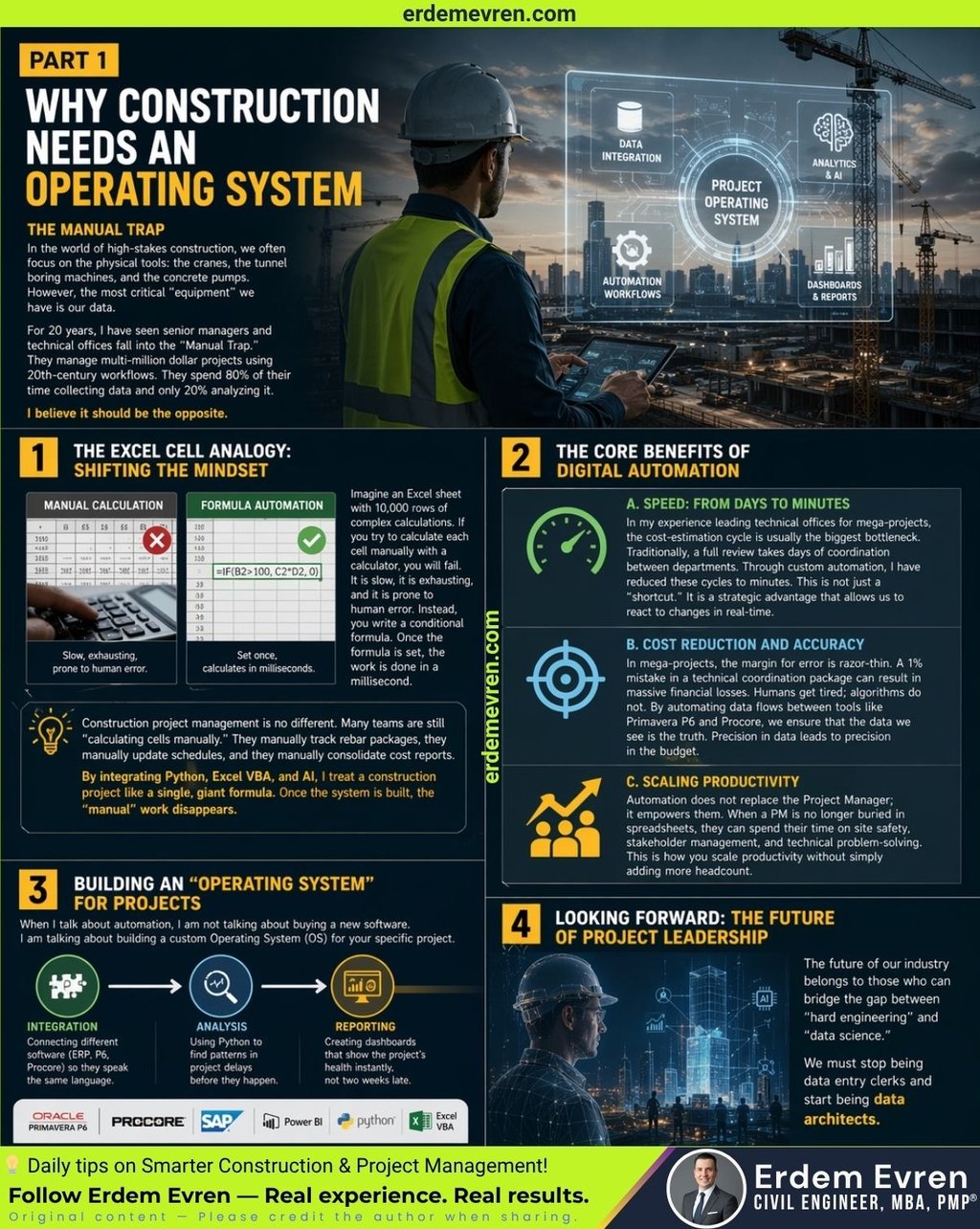
The Manual Trap
In the world of high-stakes construction, we often focus on the physical tools: the cranes, the tunnel boring machines, and the concrete pumps. However, the most critical "equipment" we have is our data.
For 20 years, I have seen senior managers and technical offices fall into the "Manual Trap." They manage multi-million dollar projects using 20th-century workflows. They spend 80% of their time collecting data and only 20% analyzing it.
I believe it should be the opposite.
1. The Excel Cell Analogy: Shifting the Mindset
Imagine an Excel sheet with 10,000 rows of complex calculations. If you try to calculate each cell manually with a calculator, you will fail. It is slow, it is exhausting, and it is prone to human error. Instead, you write a conditional formula. Once the formula is set, the work is done in a millisecond.
Construction project management is no different. Many teams are still "calculating cells manually." They manually track rebar packages, they manually update schedules, and they manually consolidate cost reports.
By integrating Python, Excel VBA, and AI, I treat a construction project like a single, giant formula. Once the system is built, the "manual" work disappears.
2. The Core Benefits of Digital Automation
A. Speed: From Days to Minutes
In my experience leading technical offices for mega-projects, the cost-estimation cycle is usually the biggest bottleneck. Traditionally, a full review takes days of coordination between departments. Through custom automation, I have reduced these cycles to minutes. This is not just a "shortcut." It is a strategic advantage that allows us to react to changes in real-time.
B. Cost Reduction and Accuracy
In mega-projects, the margin for error is razor-thin. A 1% mistake in a technical coordination package can result in massive financial losses. Humans get tired; algorithms do not. By automating data flows between tools like Primavera P6 and Procore, we ensure that the data we see is the truth. Precision in data leads to precision in the budget.
C. Scaling Productivity
Automation does not replace the Project Manager; it empowers them. When a PM is no longer buried in spreadsheets, they can spend their time on site safety, stakeholder management, and technical problem-solving. This is how you scale productivity without simply adding more headcount.
3. Building an "Operating System" for Projects
When I talk about automation, I am not talking about buying a new software. I am talking about building a custom Operating System (OS) for your specific project.
Integration: Connecting different software (ERP, P6, Procore) so they speak the same language.
Analysis: Using Python to find patterns in project delays before they happen.
Reporting: Creating dashboards that show the project's health instantly, not two weeks late.
4. Looking Forward: The Future of Project Leadership
The future of our industry belongs to those who can bridge the gap between "hard engineering" and "data science." We must stop being data entry clerks and start being data architects.
The question for leadership is no longer "How many people do we need for this project?" but "How efficient is the system we are using to manage it?"
Part 2: The Architecture of an Automated Site
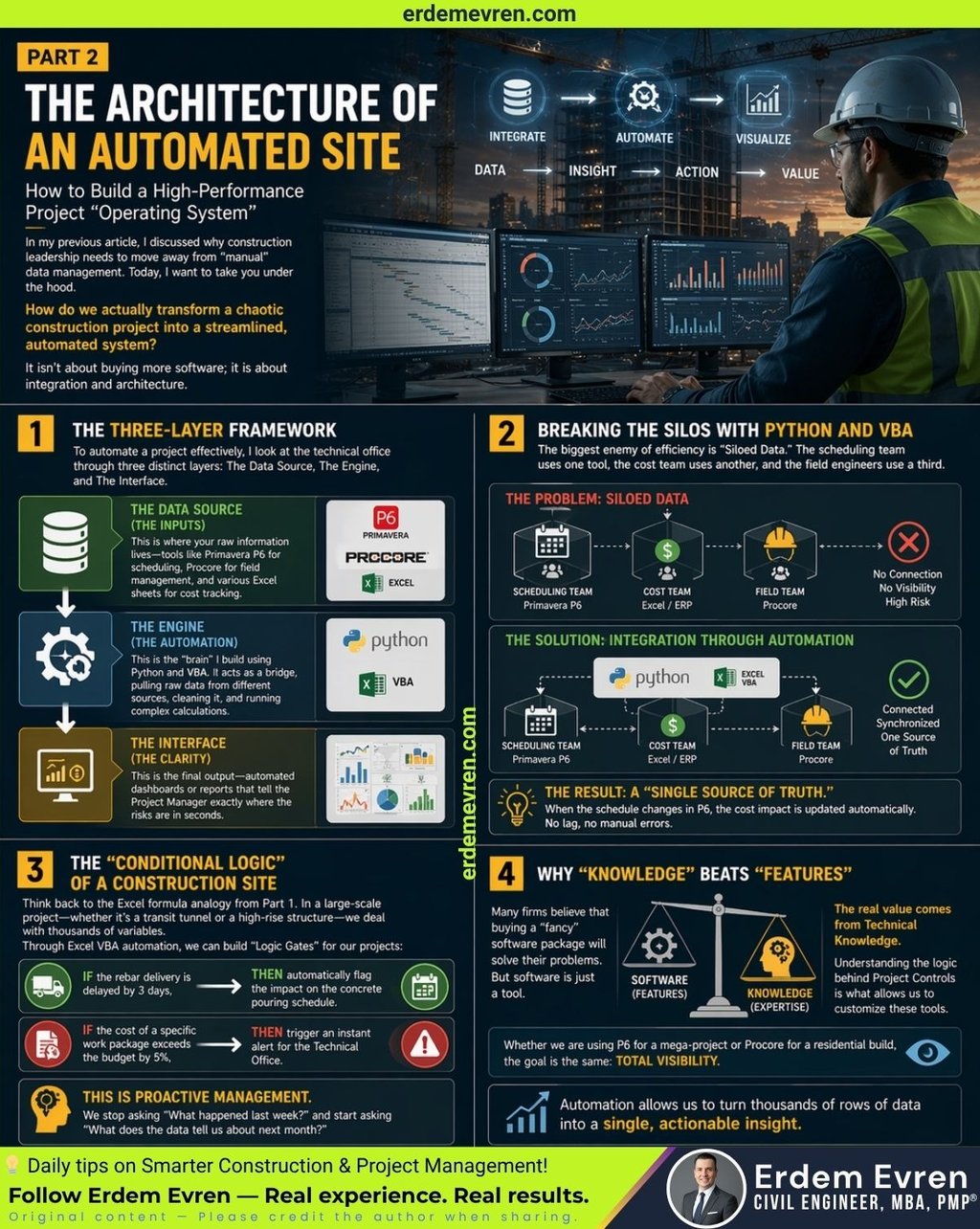
How to Build a High-Performance Project "Operating System"
In my previous article, I discussed why construction leadership needs to move away from "manual" data management. Today, I want to take you under the hood.
How do we actually transform a chaotic construction project into a streamlined, automated system? It isn't about buying more software; it is about integration and architecture.
1. The Three-Layer Framework
To automate a project effectively, I look at the technical office through three distinct layers: The Data Source, The Engine, and The Interface.
The Data Source (The Inputs): This is where your raw information lives—tools like Primavera P6 for scheduling, Procore for field management, and various Excel sheets for cost tracking.
The Engine (The Automation): This is the "brain" I build using Python and VBA. It acts as a bridge, pulling raw data from different sources, cleaning it, and running complex calculations.
The Interface (The Clarity): This is the final output—automated dashboards or reports that tell the Project Manager exactly where the risks are in seconds.
2. Breaking the Silos with Python and VBA
The biggest enemy of efficiency is "Siloed Data." The scheduling team uses one tool, the cost team uses another, and the field engineers use a third.
By using Python, I create scripts that talk to all these tools simultaneously. Instead of a human spending 10 hours exporting, copying, and pasting data between systems, a script does it in 10 seconds.
The Result: A "Single Source of Truth." When the schedule changes in P6, the cost impact is updated automatically. No lag, no manual errors.
3. The "Conditional Logic" of a Construction Site
Think back to the Excel formula analogy from Part 1. In a large-scale project—whether it’s a transit tunnel or a high-rise structure—we deal with thousands of variables.
Through Excel VBA automation, we can build "Logic Gates" for our projects:
If the rebar delivery is delayed by 3 days, then automatically flag the impact on the concrete pouring schedule.
If the cost of a specific work package exceeds the budget by 5%, then trigger an instant alert for the Technical Office.
This is Proactive Management. We stop asking "What happened last week?" and start asking "What does the data tell us about next month?"
4. Why "Knowledge" Beats "Features"
Many firms believe that buying a "fancy" software package will solve their problems. But software is just a tool.
The real value comes from Technical Knowledge. Understanding the logic behind Project Controls is what allows us to customize these tools. Whether we are using P6 for a mega-project or Procore for a residential build, the goal is the same: Total Visibility.
Automation allows us to turn thousands of rows of data into a single, actionable insight.
Part 3: The ROI of Automation
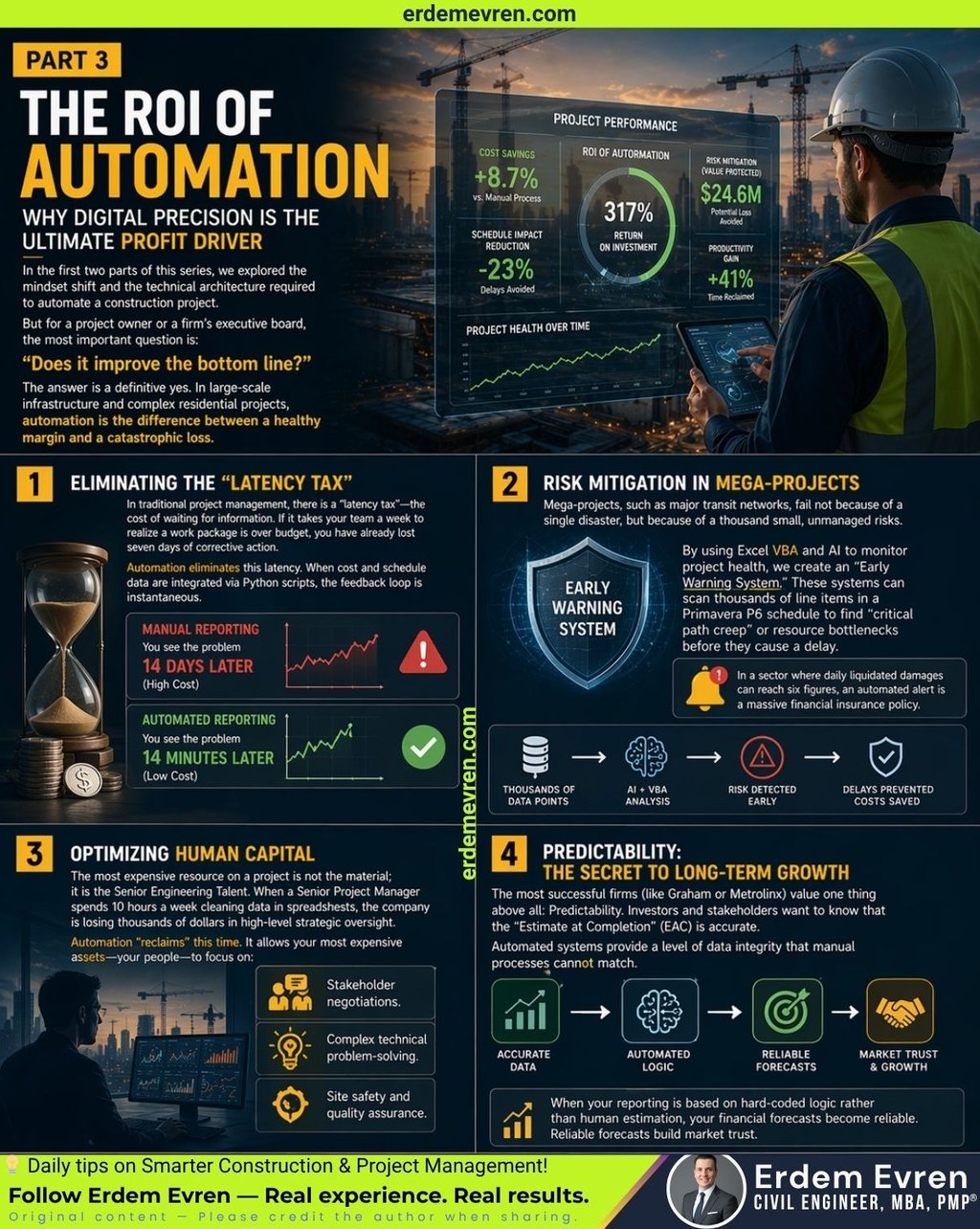
Why Digital Precision is the Ultimate Profit Driver
In the first two parts of this series, we explored the mindset shift and the technical architecture required to automate a construction project. But for a project owner or a firm’s executive board, the most important question is: "Does it improve the bottom line?"
The answer is a definitive yes. In large-scale infrastructure and complex residential projects, automation is the difference between a healthy margin and a catastrophic loss.
1. Eliminating the "Latency Tax"
In traditional project management, there is a "latency tax"—the cost of waiting for information. If it takes your team a week to realize a work package is over budget, you have already lost seven days of corrective action.
Automation eliminates this latency. When cost and schedule data are integrated via Python scripts, the feedback loop is instantaneous.
Manual Reporting: You see the problem 14 days later (High Cost).
Automated Reporting: You see the problem 14 minutes later (Low Cost).
2. Risk Mitigation in Mega-Projects
Mega-projects, such as major transit networks, fail not because of a single disaster, but because of a thousand small, unmanaged risks.
By using Excel VBA and AI to monitor project health, we create an "Early Warning System." These systems can scan thousands of line items in a Primavera P6 schedule to find "critical path creep" or resource bottlenecks before they cause a delay. In a sector where daily liquidated damages can reach six figures, an automated alert is a massive financial insurance policy.
3. Optimizing Human Capital
The most expensive resource on a project is not the material; it is the Senior Engineering Talent. When a Senior Project Manager spends 10 hours a week cleaning data in spreadsheets, the company is losing thousands of dollars in high-level strategic oversight. Automation "reclaims" this time. It allows your most expensive assets—your people—to focus on:
Stakeholder negotiations.
Complex technical problem-solving.
Site safety and quality assurance.
4. Predictability: The Secret to Long-Term Growth
The most successful firms (like Graham, AECON, PCL or major authorities like Metrolinx in Ontario) value one thing above all: Predictability. Investors and stakeholders want to know that the "Estimate at Completion" (EAC) is accurate. Automated systems provide a level of data integrity that manual processes cannot match. When your reporting is based on hard-coded logic rather than human estimation, your financial forecasts become reliable. Reliable forecasts build market trust.
Part 4: The Intelligent Site
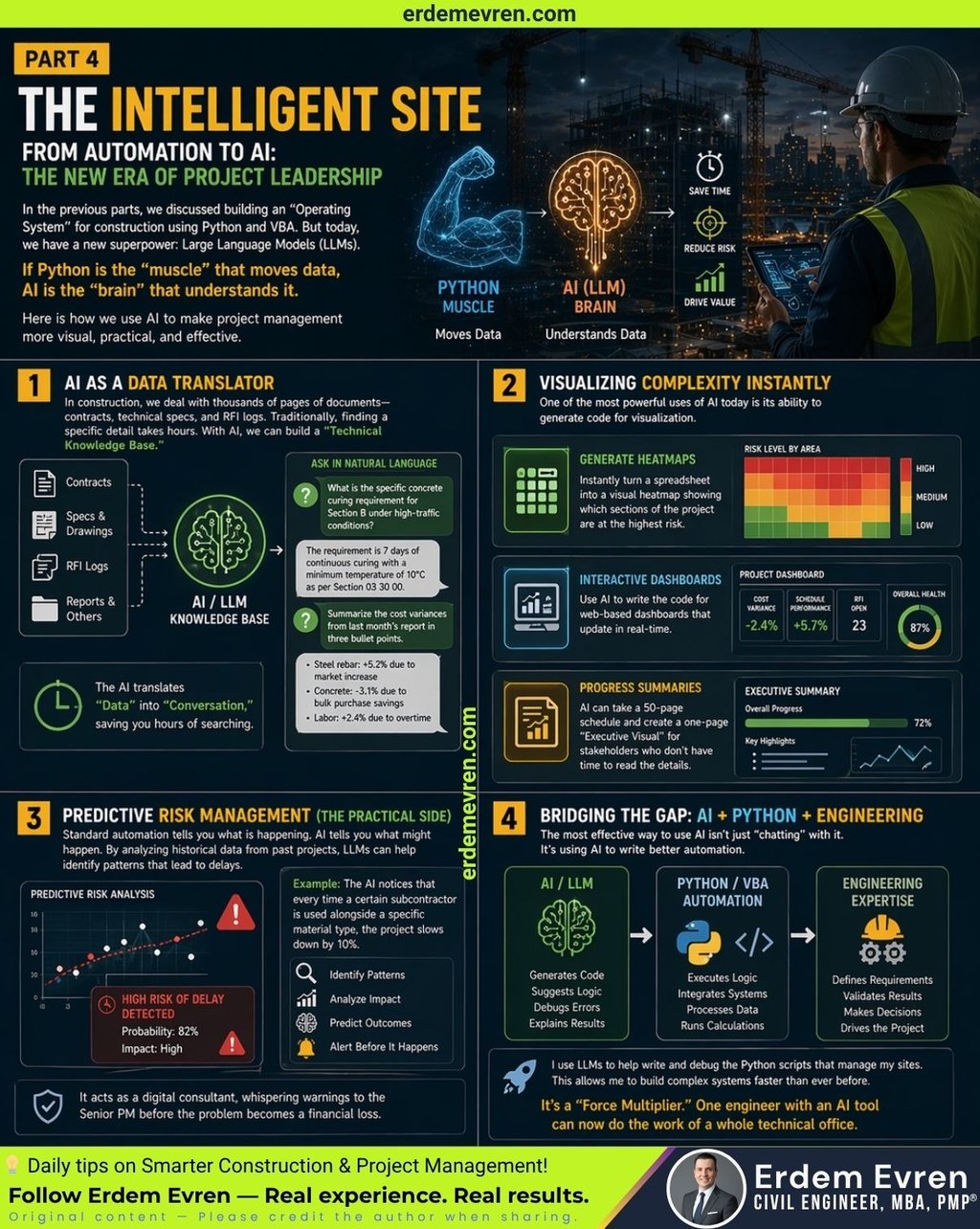
From Automation to AI: The New Era of Project Leadership
In the previous parts, we discussed building an "Operating System" for construction using Python and VBA. But today, we have a new superpower: Large Language Models (LLMs). If Python is the "muscle" that moves data, AI is the "brain" that understands it. Here is how we use AI to make project management more visual, practical, and effective.
1. AI as a Data Translator
In construction, we deal with thousands of pages of documents—contracts, technical specs, and RFI logs. Traditionally, finding a specific detail takes hours. With AI, we can build a "Technical Knowledge Base." By feeding project documents into an LLM, a Project Manager can ask:
"What is the specific concrete curing requirement for Section B under high-traffic conditions?"
"Summarize the cost variances from last month’s report in three bullet points."
The AI translates "Data" into "Conversation," saving you hours of searching.
2. Visualizing Complexity Instantly
One of the most powerful uses of AI today is its ability to generate code for visualization. Instead of struggling with complex charting tools, you can use AI to:
Generate Heatmaps: Instantly turn a spreadsheet into a visual heatmap showing which sections of the project are at the highest risk.
Interactive Dashboards: Use AI to write the code for web-based dashboards that update in real-time.
Progress Summaries: AI can take a 50-page schedule and create a one-page "Executive Visual" for stakeholders who don't have time to read the details.
3. Predictive Risk Management (The Practical Side)
Standard automation tells you what is happening. AI tells you what might happen. By analyzing historical data from past projects, LLMs can help identify patterns that lead to delays.
Example: The AI notices that every time a certain subcontractor is used alongside a specific material type, the project slows down by 10%. It acts as a digital consultant, whispering warnings to the Senior PM before the problem becomes a financial loss.
4. Bridging the Gap: AI + Python + Engineering
The most effective way to use AI isn't just "chatting" with it. It’s using AI to write better automation. I use LLMs to help write and debug the Python scripts that manage my sites. This allows me to build complex systems faster than ever before. It’s a "Force Multiplier." One engineer with an AI tool can now do the work of a whole technical office.
Conclusion: Building the Future of Construction Leadership
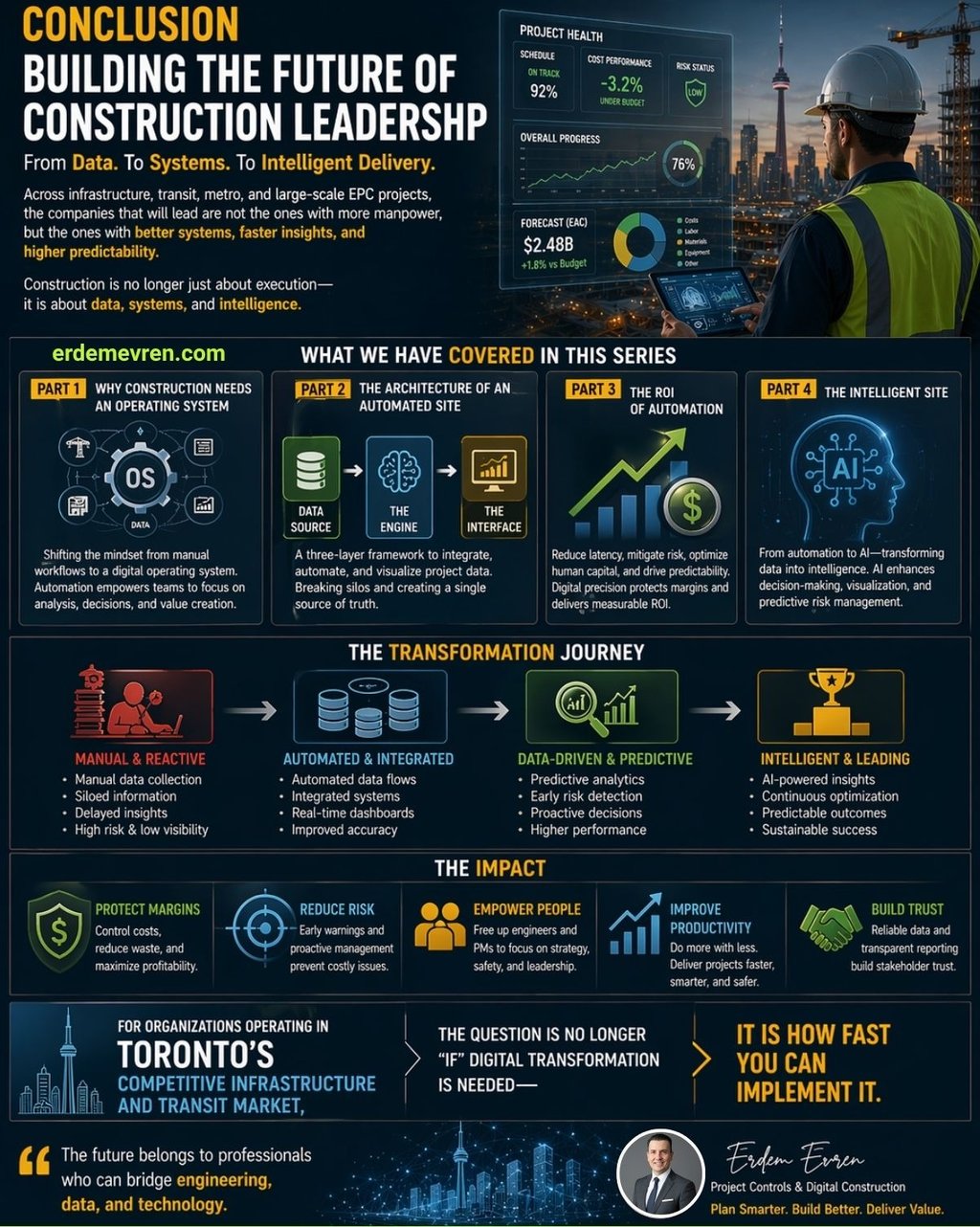
Construction is no longer just about execution; it is about data, systems, and intelligence.
Across infrastructure, transit, metro, and large-scale EPC projects, the companies that will lead are not the ones with more manpower, but the ones with better systems, faster insights, and higher predictability.
By combining Project Controls, Digital Construction, Automation (Python, VBA), and AI, we move from:
Reactive reporting → Real-time decision-making
Data silos → Integrated systems
Uncertainty → Predictable project outcomes
This is how we protect margins, reduce risk, and deliver complex projects with confidence.
For organizations operating in Toronto’s competitive infrastructure and transit market, the question is no longer if digital transformation is needed; it is how fast you can implement it.
The future belongs to professionals who can bridge engineering, data, and technology.
Build systems. Drive efficiency. Deliver certainty.
On-Site Examples from My Experience
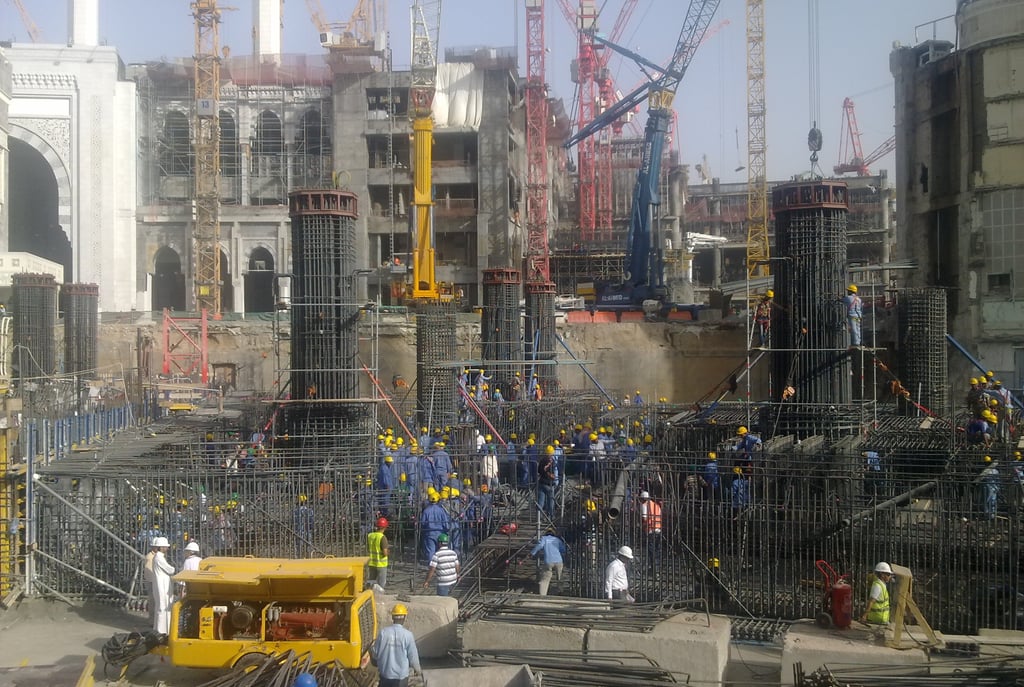
E1 > The Increasing Mataf Capacity Project / Megaproject
Imagine hundreds of construction workers on a massive mega-project, standing completely still. They aren't on a break, they are waiting for a single piece of paper.
During the Increasing Mataf project, we faced a daily crisis that revolved around one critical detail: the Bar Bending Schedules. Every single day, engineers had to manually calculate and type out the exact length, thickness, shape, and quantity of every piece of reinforcement steel. The pressure was enormous. A single typo meant the steel would be cut incorrectly. If that happened, not only would highly expensive material go straight to the scrap pile, but entire crews would be left idle for days while we tried to fix the mistake. The financial cost of a simple human error was terrifyingly high, and the daily workload of entering data into spreadsheets was exhausting.
Instead of accepting this manual trap, I decided to stop the cycle. I stepped away from the daily data entry and spent a few intense days building a centralized rebar automation system from scratch. I created a living database categorized by rebar types, sizes, and specific project locations. To make it completely foolproof, I even integrated visual shapes directly into the system so the workshop knew exactly what to bend without any second-guessing.
The transformation was like flipping a switch. Before, teams spent agonizing hours manually entering data row by row, praying they didn't make a mistake. After the system went live, all I had to do was type a simple location, like "Column 2." In mere seconds, a flawless ten-page technical report would generate automatically. What used to take days of stressful, error-prone work was reduced to a few clicks, and our mistake rate dropped to absolute zero. The site never had to wait for a steel schedule again.
It taught me the ultimate lesson in project management: in a high-stakes environment, the goal isn't to just work harder. The goal is to build a system that makes failure impossible.
E2 > Riyadh Metro Project / Megaproject
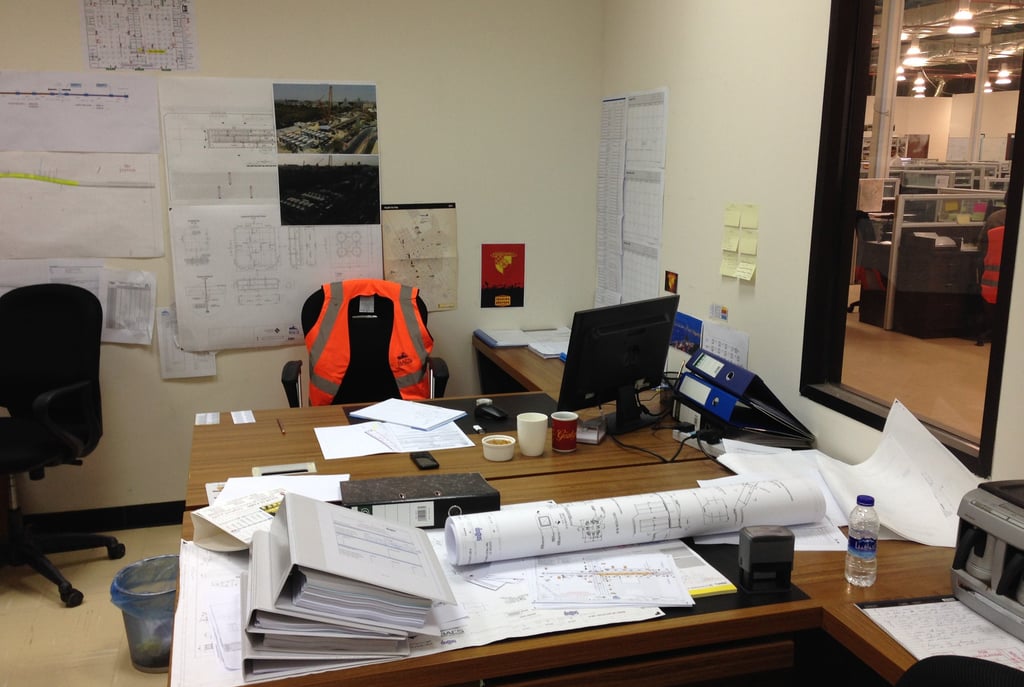
In the middle of the massive Riyadh Metro project, we were moving fast, but our data was moving slow. Every day, mountains of site reports, grouting logs, and injection records were being filled out by hand. Because everything was manual, we only saw our costs and progress once a week, or sometimes once a month. By the time we saw a problem in the budget, it was often too late to fix it. We were driving a fast car, but we were looking at the rearview mirror instead of the road ahead.
I knew we needed a "live" system, so I used Excel VBA to transform our entire reporting process into a digital engine. I built a comprehensive database where every machine type and every specific task was pre-loaded. Instead of engineers typing out the same details every single day, they could simply select options from a smart list. What used to be a tedious hour of manual data entry was reduced to just a few seconds. Suddenly, the data wasn't just sitting in a file; it was alive.
This automation changed everything. We moved from monthly financial snapshots to a daily dashboard. I could now track every dollar spent in real-time. If a specific section of the tunnel was costing more than expected, we didn't have to wait three weeks to find out; we knew by sunset that same day. This gave us the power to take action immediately, fix inefficiencies, and prevent small issues from becoming multi-million dollar disasters.
We stopped guessing and started knowing. By turning thousands of manual entries into a single, automated source of truth, we didn't just save time; we gained the foresight to manage one of the world's largest infrastructure projects with total precision.
E3 > Modular Home Additions / Timber Frame Projects
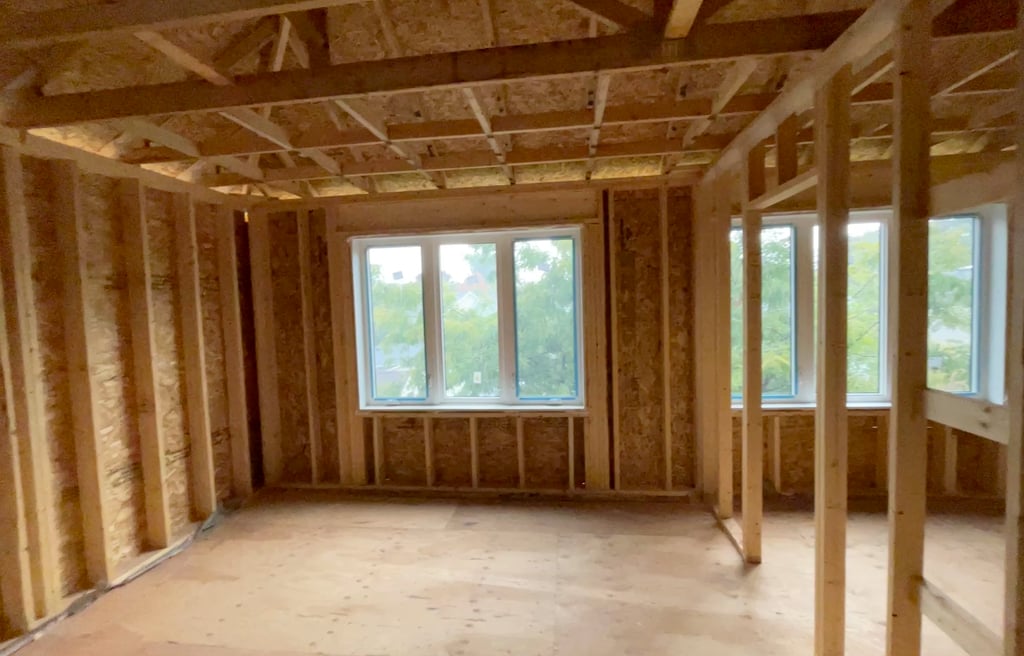
Managing construction in Toronto is an entirely different beast, especially when you are juggling modular home additions, complex renovations, and custom new builds all at once. While the budgets for these individual homes were smaller than global mega-projects, the operational complexity was actually challenging, too. Imagine trying to keep fifteen different plates spinning in the air, with each project at a completely different stage of construction. On any given day, I was managing material orders, running detailed estimates, holding weekly client meetings, securing building permits to keep the sites moving, processing constant change orders, and collecting payments. The biggest bottleneck was the paperwork. Our cost calculations and contracts involved over 300 distinct line items. Manually calculating and writing these out for every single house took days of exhausting work, stealing valuable time away from actually managing the builds.
I realized I couldn't simply work harder to keep up with the volume; I had to completely change how we operated. I took all 300 work items and built a comprehensive database, linking every single line item directly to our financial and contract files using custom code. Instead of manually writing out contracts and calculating costs from scratch, I transformed the process into a smart selection tool. From then on, my only job was to study the architectural plans and select the necessary items from the database. The system would instantly and automatically generate precise cost estimates and flawless contracts. A workload that used to consume days of my week shrank down to just thirty minutes.
But getting the paperwork signed was only half the battle; I still had to build the houses. To maintain control over fifteen active sites, I developed a custom operating system with a central digital dashboard. It gave me a bird's-eye view of every single project in real-time. I programmed it so that if a material delivery was falling behind schedule or if there was a discrepancy in a contract, the system would immediately trigger a notification. Instead of constantly chasing problems across the city, the problems reported themselves directly to me. I no longer had to rely on my memory to manage a million moving parts; I just kept the data updated and let the system run the show.
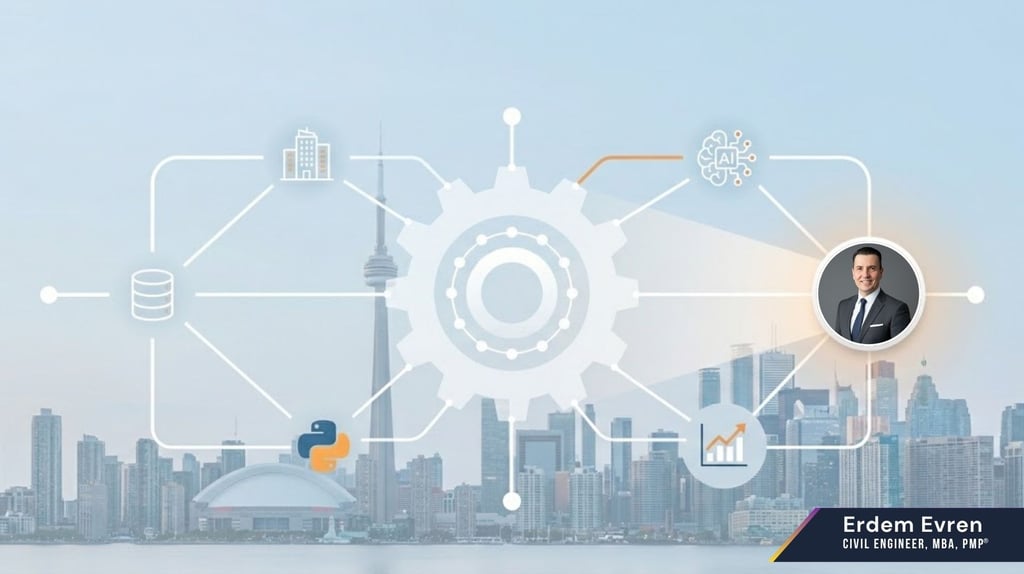

Connecting the Dots
With nearly 20 years of hands-on experience in global construction projects, my focus has always been on one thing: building systems that make success predictable.
I am particularly interested in engaging with large-scale infrastructure and transit teams in the Greater Toronto Area that value Smart Construction Management and Advanced Project Controls.
If you are looking to move beyond manual reporting and bring more structural efficiency to your project’s DNA, I’d be glad to contribute my expertise.
Let’s connect to discuss how we can drive certainty into your next complex build.
Real Insights. Smarter Projects. Better Results.
SUBSCRIBE NOW FOR ADVANCED CONSTRUCTION PROJECT MANAGEMENT INSIGHTS.
Subscribe to my newsletter
Enjoy exclusive special deals available only to my subscribers.